China’s folding-shelf market serves homes, workshops, retailers, and compact commercial spaces. Buyers comparing manufacturers and suppliers should look beyond a neat product photo. Hinge movement, shelf depth, edge finishing, load ratings, and clear installation instructions all affect everyday use.
Fortune Business Insights estimated the global furniture market at USD 736.家具 billion in 2023, with further growth projected in its market report. That figure covers furniture broadly, not Folding Shelves alone. This distinction matters. It offers market context, not proof of demand for any single product. For buyers sourcing from China, sample testing and documented specifications remain more useful than broad market forecasts.
The designer Charles Eames said, “The details are not the details. They make the design.” It is a useful principle for Folding Shelves: a hinge that catches, or a thin coating that chips, can undermine an otherwise attractive unit. Details matter. Compare material thickness, finish consistency, hardware, packaging, and the supplier’s quality-control process. Ask for load-test evidence relevant to the exact model, rather than relying on a general claim. A wall-mounted shelf also depends on the wall and fixing method, so one rating cannot suit every installation. Some product pages leave this unclear. That deserves scrutiny. This guide introduces China-based manufacturers and suppliers while encouraging practical checks, honest comparisons, and questions that reveal what a catalog cannot.
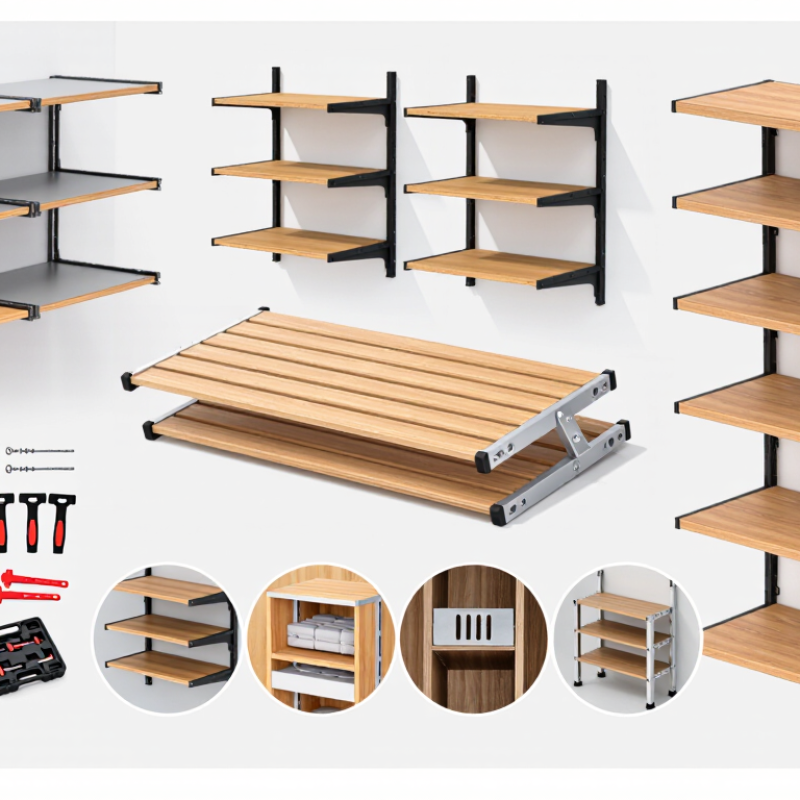
A folding shelf is a storage surface that pivots on hinges or support brackets, then folds close to a wall or frame. It creates a usable platform without permanently occupying the same space. Common designs use wood, metal, or molded materials, with different depths and mounting systems. Space is precious. A properly installed shelf should stay level and fold smoothly.
In kitchens, a compact shelf can hold jars or a kettle near a worktop. In a garage, a deeper model may support small tool cases, provided its rated capacity suits the load. Laundry rooms, workshops, temporary display areas, and small apartments also benefit from shelves that can be tucked away. Keep the folded panel clear of doors and walkways. It sounds obvious, but that detail is easy to miss.
When comparing folding shelf manufacturers and suppliers, check dimensions, materials, hinge quality, mounting instructions, and stated load limits. Ask whether the rating applies to evenly distributed weight or a concentrated load. Wall type matters too; masonry and drywall need different fixings. A sturdy shelf is not automatically suitable for every wall. In practice, the simplest design may be the most convenient, though it can offer less storage depth.
| Folding Shelf Type | How It Folds | Common Materials | Typical Applications | Installation or Placement | Practical Considerations |
|---|---|---|---|---|---|
| Wall-mounted drop-leaf shelf | The shelf panel pivots down when not in use and is raised to create a horizontal surface. | Solid wood, plywood, metal, or plastic, depending on the design. | Kitchens, laundry rooms, workshops, compact home offices, and small retail spaces. | Attached to a wall; suitable wall structure and secure fixings are essential. | Check the product’s load rating and required wall fixings. Keep the folding area clear during operation. |
| Folding-bracket wall shelf | Hinged support brackets fold toward the wall, allowing the shelf board to be lowered. | Wood or engineered-wood shelf boards with steel or aluminum brackets. | Garages, utility rooms, workshops, storage areas, and temporary work surfaces. | Wall-mounted, with brackets fixed into suitable structural support. | Bracket capacity, shelf depth, fixing method, and wall construction all affect safe loading. |
| Folding workbench shelf | A work surface folds vertically against a wall or folds into a compact frame. | Steel frames with wood, plywood, or composite worktops. | Home workshops, garages, maintenance areas, and maker spaces where floor space is limited. | Usually wall-mounted or supported by a folding frame; some models are portable. | Use a workbench designed for the intended task. Do not assume a storage shelf has the same work-surface rating. |
| Freestanding folding utility shelf | Shelves and frame sections collapse or fold together for storage and transport. | Steel, aluminum, plastic, or combinations of these materials. | Pantries, event setups, temporary storage, garages, and household organization. | Placed on the floor; no permanent wall mounting is generally required. | Open and lock the frame fully before loading. Place it on a level surface and distribute items evenly. |
| Folding laundry or drying shelf | Racks or shelf panels fold inward when drying or storage space is not needed. | Coated steel, stainless steel, aluminum, wood, or plastic. | Laundry rooms, bathrooms, balconies, and other household drying areas. | Available as wall-mounted or freestanding designs; use outdoors only when the materials are suitable. | Consider moisture resistance, ventilation, available clearance, and the product’s stated load limits. |
| Compact-vehicle folding shelf | A small surface folds away or pivots into a stowed position within a vehicle interior. | Lightweight plywood, aluminum, plastic, or coated metal. | Recreational vehicles, camper interiors, boats, and other space-constrained environments. | Fitted to an appropriate interior structure; installation must account for movement and vibration. | Choose hardware and materials suited to the environment. Secure the shelf and stored items during travel. |
Note: Folding-shelf designs, dimensions, materials, and load ratings vary by model. Always follow the product instructions and use suitable mounting hardware for the installation surface.
It pivots on hinges or brackets and folds against a wall or frame. Space stays open when the shelf is not needed.
They can hold jars or a kettle in kitchens, or small tool cases in garages. Laundry rooms and small apartments may benefit too.
Compare its dimensions, material, hinge quality, mounting instructions, and stated load limit. Ask whether the limit applies to evenly spread weight or one concentrated load.
No. Masonry and drywall need different fixings, and the shelf must suit the wall. A sturdy shelf is not automatically a safe fit.
Production usually starts with a design review covering dimensions, hinges, clearances, and intended loads. Materials may include steel, aluminum, engineered wood, or a combination.
Metal sheets or tubes are cut, punched, and formed, then cleaned and coated. Wooden panels are cut, drilled, and edge-finished before brackets and hinges are fitted.
Workers typically open and close each mechanism and inspect its edges, fasteners, and finish. Even a small alignment error can make a shelf scrape or sit unevenly.
No. Results depend on how the shelf is mounted, so factory tests cannot represent every wall or installation. That limitation is easy to miss.
Clear drawings, agreed inspection criteria, and a checked production sample can help. They cannot prevent every defect, and some manual adjustment may still be needed.
Folding Shelves are space-saving storage solutions designed to fold away when they are not in use. They are commonly used in homes, offices, workshops, retail spaces, and other settings where flexible storage or display space is valuable. Available in wall-mounted and freestanding designs, they may be made from materials such as steel, aluminum, wood, or plastic, with features including adjustable brackets, protective finishes, and different load capacities.
In China, folding shelves are manufactured through processes that can include material cutting, forming, welding or assembly, surface treatment, and quality inspection. When evaluating suppliers, buyers can consider product design, material consistency, workmanship, customization options, production capacity, communication, and delivery arrangements. Comparing these factors helps identify manufacturers and suppliers suited to specific requirements, whether for compact household storage or more demanding commercial use.

 CoreStorage