Choosing among China’s top Slatwall Displays manufacturers takes more than comparing catalog photos. Buyers should examine panel materials, finish consistency, load-bearing hardware, customization options, and export experience. A smooth-looking board may still disappoint if its grooves vary or accessories fit loosely.
Retail-fixture consultant Jeff Green is often associated with this practical principle: “A display must make products easy to see, reach, and replenish.” This is an editorial summary, not a verified verbatim quotation. It captures a useful test for Slatwall Displays: inspect how hooks, shelves, and baskets work together in a real store layout. Ask suppliers for close-up production images, material specifications, sample panels, and clear packaging details. Small checks matter.
This guide introduces ten Chinese manufacturers and compares their product focus, customization capabilities, and communication practices. Some suppliers specialize in standard MDF panels; others offer laminate finishes, metal accessories, or made-to-order dimensions. Those differences affect more than appearance. They can shape installation time, replacement costs, and the way a display handles daily restocking.
No ranking can replace direct verification. Request current samples, confirm quoted specifications, and clarify what is included in each offer. A polished website is not proof of consistent production. That is an imperfect but important reality. The goal is to help buyers ask sharper questions before choosing a manufacturing partner for their next retail project.
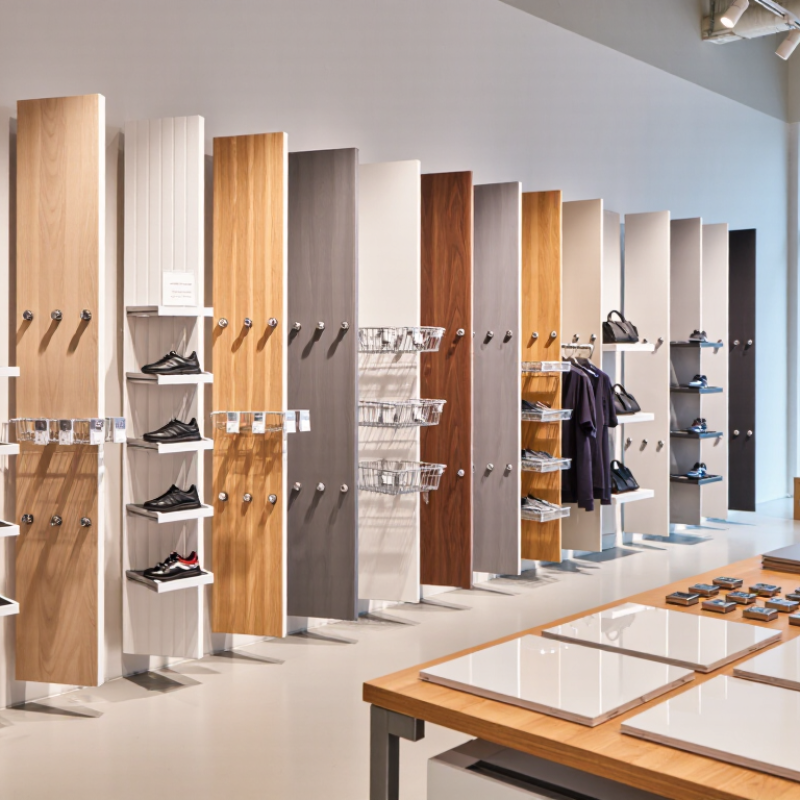
Slatwall displays are retail fixtures with horizontal grooves cut into a flat panel. Retailers insert hooks, shelves, baskets, or small brackets into these channels. The accessories can be moved without drilling new holes. Handy, but not magic. A display still needs a sensible layout.
These panels are often used for packaged goods, accessories, tools, and other lightweight merchandise. Hooks keep items visible and easy to reach, while shallow shelves suit folded products or boxed stock. A shop might place frequently handled products at eye level and heavier items lower down. Clear spacing matters. Crowded hooks make products harder to compare and can leave a panel looking untidy.
Materials and installation affect daily performance. Panels may use engineered wood, metal, or plastic, and each handles weight and wear differently. Before loading one, check the fixture maker’s stated capacity and the strength of the wall or support system. That detail is easy to overlook. In a busy store, staff may rearrange accessories often, so sturdy fittings and smooth groove edges help reduce wear. Lighting, aisle width, and customer reach also shape the setup. A layout that looks neat in a photograph may feel awkward when shoppers use it.
China’s slatwall display industry is better understood as a connected supply chain than as one factory category. Panel manufacturers cut engineered boards, route horizontal grooves, and apply laminate, melamine, or painted finishes. Metal insert suppliers reinforce grooves, while accessory workshops produce hooks, shelves, bins, and brackets. Some factories manage these steps in-house; others use nearby subcontractors. Details matter here.
A second layer consists of display-system integrators. They turn panels and accessories into shop fixtures, combining slatwall with steel frames, counters, lighting, or signage. Their work often includes drawing review, sample production, packaging design, and checks for dimensions, surface consistency, and load performance. For export orders, packaging is practical engineering: a damaged corner can make a sound panel costly to install. Capabilities vary widely, even among suppliers with similar catalogs.
The industry also includes trading and sourcing companies that coordinate multiple workshops. This can simplify purchasing, but it may reduce visibility into materials and production changes. Buyers should ask who makes the panels, how groove spacing is checked, and whether accessory finishes match the approved sample. A polished sample is useful, not conclusive. I would also compare repeat-order consistency, since small color or cutting differences can become obvious across a full retail wall. These checks reveal more than a broad claim of factory capability.
| Industry Layer | Typical Products or Inputs | Core Manufacturing Activities | Common Materials | Typical Buyer Requirements |
|---|---|---|---|---|
| Panel and board supply | Substrates used to make slatwall panels and display fixtures | Board production, cutting, grading, and preparation for downstream fabrication | MDF, particleboard, plywood, and other engineered wood panels | Consistent thickness, flatness, surface quality, and suitability for the intended finish |
| Slatwall panel fabrication | Grooved panels for retail walls, display areas, and shopfitting projects | Panel sizing, groove routing, edge finishing, and installation of compatible groove inserts where specified | Engineered wood panels, decorative laminates, veneers, coatings, and metal or plastic inserts | Specified panel dimensions, groove layout, finish, insert compatibility, and repeatable production quality |
| Surface finishing and customization | Panels supplied in project-specific colors, textures, or decorative finishes | Lamination, veneer application, painting, edge treatment, and finish matching | High-pressure or other decorative laminates, paper foils, wood veneers, paints, and edge materials | Appearance consistency, finish durability, sample approval, and alignment with store design specifications |
| Metal display accessories | Hooks, brackets, shelves, rails, and other slatwall-compatible fittings | Metal forming, cutting, welding, finishing, and assembly | Steel wire, sheet steel, aluminum, and protective or decorative coatings | Compatibility with the panel system, load suitability, finish, and required accessory configuration |
| Plastic and mixed-material accessories | Product holders, bins, signage components, and fittings used with display panels | Molding, cutting, forming, printing, and assembly, depending on the product design | Common plastics, metals, and combinations of materials | Fit, visibility, product compatibility, color, and the intended retail application |
| Complete display and fixture assembly | Combined panel-and-accessory solutions or display units prepared for installation | Component selection, pre-assembly, quality checks, and project-specific configuration | Slatwall panels, metal fittings, shelves, frames, and other fixture components | Coordinated specifications, assembly instructions, installation requirements, and consistent component fit |
| OEM and project customization | Private-label or made-to-specification panels, accessories, and display packages | Specification review, drawings or samples, production planning, and customized finishing or packing | Materials selected according to the approved product specification | Clear drawings, approved samples, tolerances, finish references, order quantities, and inspection criteria |
| Quality control and compliance support | Inspection records and product documentation for panels, fittings, or complete orders | Incoming-material checks, in-process inspection, final checks, and preparation of requested documentation | Applicable to all materials and finished components in the order | Agreed inspection plans, traceable specifications, packaging checks, and destination-market requirements |
| Export packing and order fulfillment | Retail display products packed for domestic shipment or international transport | Protective packing, labeling, carton or pallet preparation, and shipment coordination | Cartons, protective materials, pallets, and product-specific packing components | Packaging dimensions, protection against handling damage, labeling instructions, and shipment documentation |
When evaluating Chinese slatwall display manufacturers, look beyond catalog photos. Ask for drawings that show panel dimensions, groove spacing, material thickness, and edge details. These affect whether hooks and shelves fit securely. Request a sample made with the same materials and finish as the production order. Inspect the groove edges, surface coating, and back of the panel—not just the front. A smooth sample is useful, but it cannot prove consistent production quality.
Ask how the manufacturer checks load capacity and keeps measurements consistent between batches. Request test details, inspection records, and clear material specifications. Confirm production capacity, lead time, packaging method, and how defects are handled. A reply should address your actual questions, not just promise “good quality.” I would not treat the lowest quote as the best value; missing hardware or weak export packaging can add cost later. This part takes time. Still, clear answers matter.
Tips: Send a simple product drawing and intended use. Ask for close-up photos of panel edges and packed goods. Compare quotes line by line, including accessories, sample costs, and shipping terms. If details remain unclear, pause before approving production. A small gap in understanding can become a large mismatch.
China’s slatwall display sector serves fashion, cosmetics, electronics, and convenience retail. China’s National Bureau of Statistics reported a 3.5% rise in total retail sales during 2024. That growth increases demand for flexible wall merchandising and quick store refits. Mordor Intelligence also forecasts continued expansion in the global retail shelving market, with annual growth above 5%.
Ten notable Chinese manufacturer profiles stand out by practical capability. Profile one focuses on MDF slatwall panels. Profile two specializes in metal hook systems. Profile three combines glass, timber, and lighting. Profile four produces modular gondola walls. Profile five serves cosmetics counters. Profile six develops compact displays for small shops. Profile seven handles large retail rollouts. Profile eight offers customized printing and finishes. Profile nine emphasizes recyclable materials. Profile ten provides installation and replacement parts. These categories are more useful than vague claims about being “top.”
In factory evaluations, I would check panel density, edge sealing, load testing, and screw resistance. ISO 9001 certification helps, but it does not prove every batch is consistent. Ask for recent inspection records, packaging photographs, and a physical sample. A display may look excellent online, yet warp after humid shipping. This is where many purchasing decisions become less certain. My own preference is a supplier that documents tolerances clearly, accepts small trial orders, and explains weaknesses without decoration.
Reference dimensions commonly used for modular slatwall display production in China
The chart presents ten commonly specified slatwall panel widths, measured in millimetres. These modular sizes are frequently used for retail fixtures, showroom walls, trade displays, and shop-in-shop systems. Actual availability, materials, groove spacing, finishes, and customization options may vary by manufacturer.
Choosing among China’s slatwall display manufacturers takes more than comparing unit prices. Grand View Research estimated the global retail display market at USD 19.03 billion in 2022 and projected an 8.1% compound annual growth rate from 2023 to 2030. That growth makes supplier capacity worth checking, but market demand does not prove factory quality. Ask for material specifications, production capacity, inspection records, and a sample made to your actual dimensions.
Compare landed cost, not just the quoted panel price. Include packaging, freight, replacement parts, and the cost of custom tooling. Ask how the supplier handles defects and whether production samples match the approved sample. A factory visit or live video walkthrough can help verify equipment and quality checks, though it cannot replace independent inspection.
Ask for proof. One common blind spot is assuming every accessory fits every slatwall profile. Confirm compatibility in writing, then test a loaded sample before ordering at scale.
I would still leave room for uncertainty: color, finish, and lead times can vary between batches. Get those tolerances documented before payment.
Show panel dimensions, groove spacing, material thickness, and edge details. These determine whether hooks and shelves fit securely.
It lets you inspect the coating, groove edges, and panel back. A smooth sample still cannot guarantee consistent production. Not quite proof.
Ask for material specifications, inspection records, and load-test results. Test conditions and mounting methods should be stated clearly.
Compare landed costs, including packaging, freight, accessories, sample fees, and custom tooling. The lowest panel price may hide later costs.
Confirm that hooks and shelves match the panel profile in writing. Test a loaded sample before placing a large order.
A visit or live video walkthrough can show equipment and checks. It helps, but independent inspection may still be needed.
Confirm capacity, lead time, packaging, and defect handling. Request photos of packed goods; humid shipping can warp panels.
No. Certification can be useful, but recent inspection records and documented tolerances provide more specific evidence.
Colors, finishes, and lead times can vary between batches. Record acceptable differences before payment. That part is easy to overlook.
This article provides a practical overview of Slatwall Displays, including their structure, key features, and common applications in retail stores, exhibitions, showrooms, and commercial spaces. It explains how slatwall panels support flexible product presentation by allowing shelves, hooks, brackets, and other accessories to be adjusted according to merchandising needs. The article also examines how China’s manufacturing industry is organized, from material sourcing and product design to fabrication, finishing, quality control, and export services.
It further introduces ten notable categories of Chinese manufacturers without focusing on brand names, helping buyers understand the differences between large factories, specialized producers, custom-display workshops, and integrated suppliers. Key evaluation criteria include product quality, material options, customization ability, production capacity, pricing, communication, certifications, packaging, lead times, and after-sales support. By comparing suppliers systematically and requesting clear samples, specifications, quotations, and production evidence, buyers can select a reliable manufacturer that matches their project requirements and budget.

CoreStorage