10 Tips for Choosing the Best Modular Shelving?

Time:2026-10-09 Author:Sienna
0%

Choosing the right Modular Shelving can change how a room works every day. A well-planned system keeps books, tools, stock, or display items visible and accessible. A poor choice may create wasted corners, unstable frames, or shelves that sag under ordinary use.

This guide draws on practical storage planning and common manufacturer specifications. It considers load capacity, shelf dimensions, materials, adjustability, installation, and long-term maintenance. Measure the wall, floor space, and items before comparing products. A 900-millimeter shelf may look suitable online, yet door swings and skirting boards can reduce its usable space. Small details matter.

Safety deserves attention. Check the rated load for each shelf, not only the total unit capacity. Steel frames usually support heavier items, while wood or composite shelves can offer a warmer appearance. Adjustable systems also help when storage needs change. However, flexibility does not guarantee strength. Fixings, wall conditions, and assembly quality still influence performance.

The best choice is not always the most expensive one. It should match the environment, handling habits, budget, and expected growth. Think carefully. Some recommendations may seem obvious, but real rooms rarely behave perfectly. Uneven floors, changing inventory, and rushed installation can challenge even a carefully selected system. The following ten tips will help you compare Modular Shelving options with greater confidence and fewer costly surprises.
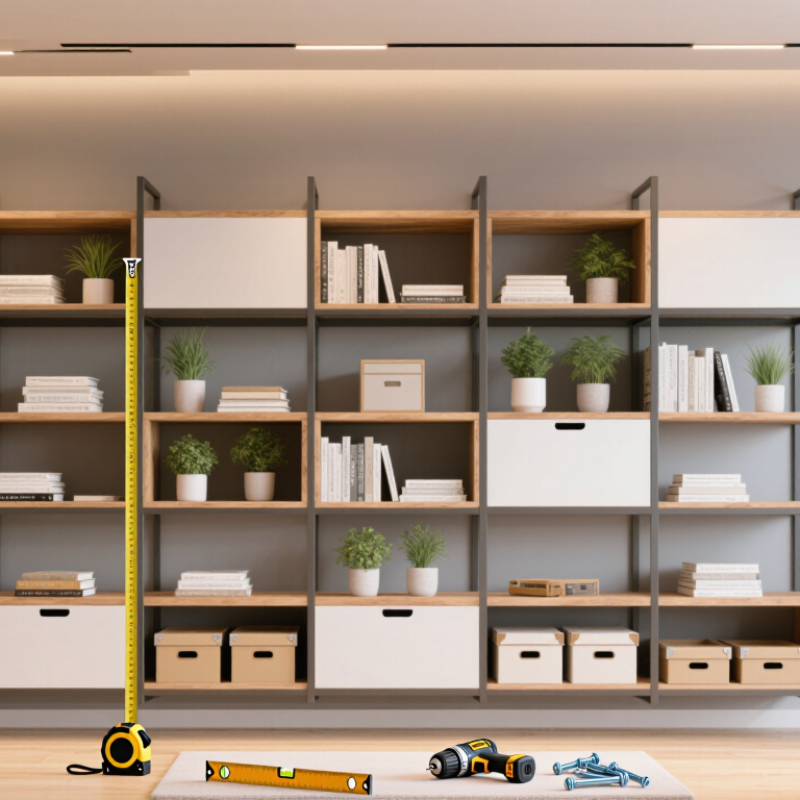
10 Tips for Choosing the Best Modular Shelving?

Define Your Storage Needs and Available Space

Choosing modular shelving begins with a clear inventory, not a product catalog. List what you store, how often you use it, and its heaviest item. A pantry may need adjustable shelves for cans, while a workshop needs deeper levels for tools. The National Association of Home Builders’ 2024 What Home Buyers Really Want report found that 81% of buyers rated a pantry essential or desirable. That figure shows how strongly storage affects everyday usability.

Measure the room in three directions: wall width, ceiling height, and usable depth. Record doors, windows, sockets, baseboards, and heating vents. Leave walking clearance before calculating shelf capacity. A 2023 National Association of Realtors Remodeling Impact Report places closet renovation among projects with strong homeowner satisfaction, but satisfaction can fall when access is ignored. I once treated a narrow corner as usable space; the finished shelves blocked the door swing. That was an avoidable mistake.

Estimate future demand, too. Keep roughly 20% open capacity for seasonal items and household changes. Use heavier lower shelves for boxes, cookware, or equipment. Lighter upper shelves suit linens and rarely used supplies. If several people share the area, label zones by user or task. Recheck your measurements on site. Walls are rarely perfectly square.

Compare Modular Shelving Materials, Strength, and Durability

Choosing the best modular shelving requires more than matching colors to a room. Compare steel, aluminum, engineered wood, and recycled plastic by strength, moisture resistance, and repairability. The 2024 World Steel in Figures report recorded about 1.89 billion tonnes of global crude steel production in 2023, showing steel’s mature supply chain and broad availability. However, thicker steel does not always mean better shelving. Check the tested load per shelf, spacing between supports, and whether the rating applies to evenly distributed weight.

Engineered wood can provide a warmer appearance, but exposed edges may swell after repeated contact with damp floors. Plastic resists rust and suits humid areas, although heat and long-term loading can cause bending. The International Aluminium Institute states that recycled aluminum requires roughly 5% of the energy used for primary production. That supports its sustainability case, but aluminum may need deeper profiles or reinforced joints for heavy storage. Look for corrosion testing based on recognized methods, such as ASTM B117, rather than vague claims like “industrial grade.”

Small details matter. Inspect the connectors by hand. Loose joints often become noisier before they become unsafe. I would also leave a safety margin below the stated maximum load, especially for books or tools. ANSI/BIFMA X5.9 testing can offer useful evidence for storage-unit performance, but it does not replace checking the actual installation, wall anchoring, and floor condition. Reports help compare materials. Real rooms remain less predictable.

10 Tips for Choosing the Best Modular Shelving? - Compare Modular Shelving Materials, Strength, and Durability

No. Selection Tip What to Compare Powder-Coated Steel Aluminum Steel Wire Wood or Engineered Wood
1 Define the required load Calculate the weight of the heaviest items on one shelf, not only the total system load. Confirm whether the rating applies to evenly distributed or point loads. Usually the strongest option for heavy, evenly distributed storage; commercial systems commonly offer approximately 68–227 kg (150–500 lb) per shelf, depending on span and construction. Good strength-to-weight ratio, but commonly lower stiffness than steel for the same shelf size; verify the manufacturer’s tested load rating. High capacity is possible when supported by reinforced beams; open wire can flex if the span is long or the load is concentrated. Suitable for light to medium loads; particleboard and MDF can sag under long-term heavy loads, especially in humid conditions.
2 Check shelf-span strength Compare shelf depth, width, beam profile, thickness, center supports, and the maximum permitted span. Shorter spans and center reinforcement generally reduce deflection and increase usable capacity. Lightweight but more prone to bending when spans are wide; select deeper profiles or additional supports for heavy storage. The grid allows air circulation, but narrow wires may leave unsupported areas beneath small or dense objects. Solid panels support small items well, but wide unsupported panels may bow over time.
3 Evaluate corrosion resistance Match the material and finish to humidity, condensation, cleaning chemicals, salt air, and outdoor exposure. Powder coating resists normal indoor wear and moisture, but scratches and cut edges can expose steel to rust. Naturally forms a protective oxide layer and is generally well suited to humid environments; contact with dissimilar metals can cause galvanic corrosion. Zinc plating or powder coating improves resistance; exposed steel at damaged areas may rust. Wood products absorb moisture and may swell, delaminate, or develop mold without appropriate sealing and ventilation.
4 Compare long-term durability Consider impact resistance, repeated assembly, vibration, abrasion, and expected service life. Strong and impact-resistant; suitable for warehouses, garages, workshops, and frequent use. Does not rust like ordinary steel, but softer surfaces can dent or scratch more easily under impact. Durable for general storage; welds, connectors, and coating quality strongly affect service life. Can last for years indoors, but edges, fasteners, and surface finishes may degrade sooner under heavy use.
5 Choose the right shelf surface Check whether the shelves must hold small parts, liquid containers, boxes, or irregular items. Solid steel panels prevent small items from falling through and are easy to wipe clean. Often paired with solid panels or composite inserts; confirm that the surface is compatible with the intended load. Excellent airflow and visibility; add shelf liners for small parts, bottles, or unstable items. Provides a continuous surface and reduces item movement, but is less suitable for wet or poorly ventilated locations.
6 Measure available space Measure width, depth, height, door clearance, ceiling clearance, and access routes before ordering. Rigid frames need accurate measurements; adjustable beams can help optimize vertical space. Lightweight components are easier to transport into tight spaces and can be practical for upper-level storage. Adjustable shelf heights make it easier to accommodate changing item sizes and reduce wasted space. Panels may be bulky and less adaptable after installation; allow space for doors, drawers, or trim.
7 Prioritize adjustability Look for tool-free shelf adjustment, compatible accessories, and a hole or slot spacing that supports the required increments. Boltless and slotted systems can be highly configurable; verify that adjustments do not reduce the stated capacity. Modular and easy to reconfigure, although lightweight connectors must be tightened correctly to prevent movement. Typically offers fine height adjustment and a wide range of hooks, dividers, and liners. Adjustability depends on the hardware; fixed-panel designs are less flexible than slotted metal systems.
8 Inspect connection security Review joint design, locking pins, bolts, welds, bracing, and whether the frame can be anchored. Rigid bolted or welded joints provide strong structural stability; anchoring is recommended for tall units. Mechanical connectors should fit tightly; cross-bracing may be needed to limit side-to-side sway. Post-and-sleeve connections are quick to assemble, while wall anchors or braces improve stability. Fastener quality and panel joints are critical; wall attachment is especially important for tall or narrow units.
9 Consider maintenance needs Compare cleaning methods, replacement parts, coating repair, and inspection requirements. Usually requires only routine dusting and mild detergent; repair chipped coating promptly to limit rust. Low routine maintenance; avoid harsh alkaline cleaners that can damage the surface. Easy to clean and inspect because of its open design; check connectors and coating for wear. May need sealing, edge protection, and careful cleaning; standing water should be avoided.
10 Balance weight, cost, and sustainability Compare purchase price, installation effort, transport weight, repairability, recyclability, and expected service life. High strength and widely recyclable; heavier than aluminum and may require more effort to move. Lightweight and highly recyclable; material cost can be higher, but transport and handling may be easier. Efficient use of metal and generally recyclable; total value depends on coating and connector durability. Often economical and visually warm; recycling and moisture resistance depend on the panel composition and finish.

Note: Shelf capacity varies significantly with dimensions, material thickness, support spacing, connection design, and load distribution. Always follow the supplier’s tested load rating, installation instructions, and anchoring requirements.

Evaluate Adjustability, Configuration, and Future Expansion

Modular shelving earns its value when it changes with your inventory. Measure the room, then test shelf heights with actual cartons, binders, or tools. Adjustable holes should prevent awkward gaps. A loose fit becomes wasted volume.

The 2023 MHI Annual Industry Report found that 83% of respondents planned to increase supply-chain technology investment. That signal matters. Storage systems must support changing workflows, not only today’s stock. Choose uprights, shelves, braces, and connectors that can be reconfigured without specialist tools. Check load ratings at every level.

Configuration also deserves close attention. A straight-wall layout may suit cartons, while an L-shape can protect a walking lane. Leave access for labels, lighting, sprinklers, and cleaning. The Occupational Safety and Health Administration emphasizes clear aisles and stable storage. Treat those requirements as daily habits, not paperwork. The 2024 State of Logistics Report estimated U.S. logistics costs at $2.3 trillion in 2023, or 8.7% of GDP. Efficient space planning deserves serious attention. Reserve one empty bay, keep spare connectors, and confirm that future shelves match the original system. I have learned that a perfectly full plan can age badly. A small unused section may be the wiser choice.

10 Tips for Choosing the Best Modular Shelving

Use the weighted criteria below to compare modular shelving systems. Adjustability, configuration flexibility, and future expansion receive the highest priority because they directly affect long-term usability.

Evaluation model: the criteria weights total 100% and can be adapted to your storage requirements, available space, and expected growth.

Check Assembly Methods, Safety Features, and Maintenance

Choosing modular shelving requires more than attractive photos. Start by examining the assembly method. Clip-in systems are quick, but they may need careful alignment. Bolt-together frames usually provide stronger connections, though installation takes longer. In my installation experience, clear instructions and numbered parts reduce mistakes. Test each joint by hand before loading the shelves. A small wobble can become a serious problem later. Keep the required tools nearby.

Safety features deserve close attention. Check the stated load rating for every shelf, not only the entire unit. Place heavier boxes on lower levels to improve stability. Look for locking pins, reinforced corners, and anti-tip brackets. Wall anchoring is especially important on tall shelving or uneven floors. Never assume a level floor is truly level; use a spirit level during setup. Leave enough space between shelves for safe handling. Avoid overloading one side. It sounds obvious, yet rushed storage often creates this exact risk.

Maintenance protects both the structure and its users. Inspect connections monthly, especially after moving the unit. Tighten loose bolts, replace bent parts, and remove rust before it spreads. Wipe dust and moisture from metal surfaces with a clean, dry cloth. I once ignored a slightly loose connector because the shelf looked stable. That was poor judgment. A written inspection record may seem unnecessary, but it helps reveal repeated problems. Follow the manufacturer’s instructions, and stop using any section that shows cracking, severe corrosion, or unexpected movement.

Balance Budget, Appearance, and Long-Term Value

10 Tips for Choosing the Best Modular Shelving

Balance Budget, Appearance, and Long-Term Value

Set a realistic budget before comparing modular shelving systems. Include delivery, installation, wall anchors, and replacement parts. The cheapest option may cost more later. Measure your room carefully, including doorways, ceiling height, and nearby furniture. A simple sketch can prevent expensive mistakes.

Check each shelf’s load rating, not just its overall appearance. Heavy books, tools, and storage boxes need stronger support. Look for adjustable levels, sturdy connectors, and a stable base.

Steel, solid wood, and quality engineered panels each offer different benefits. Choose materials that suit your humidity, cleaning habits, and daily use.

Consider how the shelving will look after several years. Neutral finishes usually adapt better when your furniture changes. Inspect edges, joints, and moving parts before purchase. Assembly should be clear and manageable. I once underestimated wall unevenness, and the finished unit looked slightly tilted. That mistake changed how I evaluate installation requirements. Ask about warranties and the availability of matching shelves or connectors. A replaceable part can extend the system’s useful life. Leave some room in your budget for quality hardware. Good value is not always the lowest price. It is dependable performance, practical appearance, and flexibility when your needs change.

FAQS

How should I define my modular shelving needs?

List stored items, usage frequency, and the heaviest object. A pantry may need adjustable shelves for cans. A workshop may need deeper levels for tools. Keep about 20% open capacity.

What measurements should I take before choosing shelving?

Measure wall width, ceiling height, and usable depth. Record doors, windows, sockets, baseboards, and heating vents. Leave walking space. Walls are rarely square.

How can I avoid blocking doors or walkways?

Sketch the room before calculating shelf capacity. Include door swings and nearby furniture. I once used a narrow corner and blocked the door. That was avoidable.

Which assembly method is suitable for modular shelving?

Clip-in systems assemble quickly but require careful alignment. Bolt-together frames usually create stronger connections. Check every joint by hand before loading shelves. A small wobble matters.

What safety features should modular shelving include?

Check each shelf’s load rating, not only the total unit rating. Look for locking pins, reinforced corners, and anti-tip brackets. Anchor tall units to walls when appropriate. Use a spirit level.

How should heavy and light items be arranged?

Place boxes, cookware, and equipment on lower shelves. Store linens and rarely used supplies higher up. Avoid loading one side heavily. Balance improves stability.

How can I maintain modular shelving over time?

Inspect connections monthly, especially after moving the unit. Tighten loose bolts and replace bent parts. Wipe dust and moisture with a dry cloth. Stop using cracked or shifting sections.

How do I judge long-term value and appearance?

Include delivery, installation, anchors, and replacement parts in your budget. Choose materials that match humidity and cleaning habits. Neutral finishes adapt well. The cheapest option may disappoint later.

Should I consider future changes when planning storage?

Yes, leave space for seasonal items and household changes. Label zones by user or task when several people share the area. Ask whether matching shelves remain available. I sometimes underestimate future clutter.

Conclusion

Choosing the best Modular Shelving begins with a clear understanding of your storage needs, available floor and wall space, and the types of items you plan to organize. Consider the weight, size, and frequency of use for each item, then compare materials for strength, durability, moisture resistance, and everyday reliability. A good system should also offer adjustable shelves, flexible configurations, and the ability to expand as your storage needs change.

Before purchasing, review the assembly method and confirm that the structure includes stable connections, secure supports, and suitable safety features. Easy-to-clean surfaces and replaceable components can reduce long-term maintenance. Finally, balance the initial budget with appearance, functionality, and expected lifespan. The most valuable shelving solution is not always the cheapest option; it is the one that provides dependable performance, adapts to changing needs, complements its surroundings, and remains practical over time.

Sienna

Sienna

Sienna is a skilled marketing professional with a deep expertise in our company’s core products and services. With a passion for innovation and detail, she plays a pivotal role in crafting insightful blog posts that not only highlight the unique features of our offerings but also provide valuable......