A crowded closet rarely needs more space; it needs a clearer system. The right Stackable Storage bins can turn a wobbly pile of sweaters, pantry packets, or toy cars into an orderly, accessible setup. But “stackable” alone is not enough. A bin must support the load above it, fit its shelf, and let you reach what is inside without dismantling the whole tower. Small details matter: lid shape, handle placement, clear sides, and whether the base slides on a wire shelf.
Professional organizer Marie Kondo writes, “The question of what you want to own is actually the question of how you want to live your life.” That idea applies here: choose containers for the routines you actually have, not an imaginary perfectly organized home. Some bins suit lightweight linens; others are better for pantry staples or garage supplies. And a deep bin can become a clutter trap. This guide compares ten options by practical needs, including size, access, durability, and where each style works best. Check the listed dimensions against your shelves before buying, since product sizes and materials can vary. No bin fixes an overcrowded space by itself. The useful one is the bin you can lift, label, and put back without a struggle.
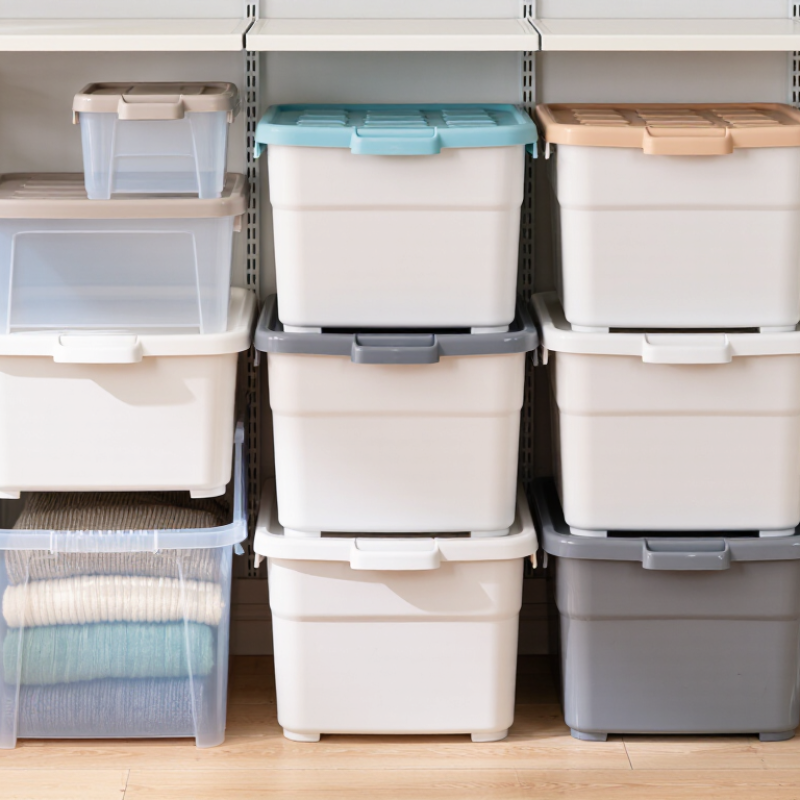
Stackable storage bins are containers designed to sit securely in vertical rows. Their lids, rims, or molded bases help keep one bin aligned above another. This turns unused air above a shelf into usable storage. Clear sides make contents easier to spot, while matching footprints reduce awkward gaps in closets, garages, and pantry shelves. Measure the shelf first; a bin that is too deep can waste space or block access. Small details matter.
The U.S. Census Bureau reported an average size of 2,411 square feet for new single-family homes in 2023, but floor area does not guarantee useful closet space. The Self Storage Association’s 2024 Fact Sheet estimates about 2 billion square feet of self-storage inventory in the United States, reflecting broad demand for extra storage. These figures do not prove that bins solve household clutter. They do show why making existing space work matters. Put seasonal linens or light supplies in higher bins, and keep heavier items low. A wobbly stack is not efficient. Leave room to pull each bin out, and label more than one side. That sounds obvious. It is easy to forget when the closet is already full.
Stackable storage bins are containers designed to sit securely on top of one another, often with matching lids, rims, or interlocking features. Vertical stacking can make better use of closet, garage, pantry, and under-bed space while keeping stored items grouped and accessible. Dimensions below are representative ranges; exact sizes and load limits vary by product.
| Bin type | Typical exterior dimensions (L × W × H) | Best suited for | How it saves space | Useful features to look for |
|---|---|---|---|---|
| Small parts bin | 8–12 × 5–8 × 4–7 in (20–30 × 13–20 × 10–18 cm) |
Screws, craft supplies, batteries, and small tools | Small footprint allows several bins to be arranged in vertical columns. | Dividers, a stable base, and a lid or stacking rim |
| Shoe storage box | 12–14 × 8–10 × 5–7 in (30–36 × 20–25 × 13–18 cm) |
Shoes, accessories, and folded small garments | Uniform-sized boxes form tidy stacks on shelves or in closets. | Clear sides, ventilation openings, and a secure lid |
| Small lidded tote | 14–18 × 10–13 × 8–11 in (36–46 × 25–33 × 20–28 cm) |
Toys, paperwork, toiletries, and household odds and ends | A manageable size fits common shelves and is easy to lift from a stack. | Latching lid, handholds, and a flat stacking surface |
| Medium general-purpose tote | 18–22 × 12–16 × 10–14 in (46–56 × 30–41 × 25–36 cm) |
Seasonal clothing, games, and household supplies | Offers useful capacity without making stacks excessively tall or heavy. | Reinforced corners, lid grooves, and comfortable handles |
| Large storage tote | 24–30 × 16–20 × 14–18 in (61–76 × 41–51 × 36–46 cm) |
Bedding, bulky toys, and lightweight seasonal items | Consolidates bulky items into fewer containers that can be stacked. | Rigid walls, a well-supported lid, and a stated load limit |
| Under-bed storage bin | 28–40 × 16–24 × 5–8 in (71–102 × 41–61 × 13–20 cm) |
Flat clothing, linens, shoes, and spare bedding | Uses the low, often unused space beneath a bed; low profiles can be stacked where clearance allows. | Wheels or glides, a low profile, and a dust-covering lid |
| Clear-front access bin | 10–16 × 12–18 × 6–10 in (25–41 × 30–46 × 15–25 cm) |
Pantry packets, toys, hobby materials, and frequently used supplies | Stacked bins can be accessed from the front without removing the one above. | Front-opening door, stack-locking edges, and transparent walls |
| Stackable drawer bin | 10–16 × 8–14 × 6–12 in (25–41 × 20–36 × 15–30 cm) |
Desk supplies, accessories, craft items, and small household goods | Combines vertical storage with pull-out access to individual contents. | Drawer stops, interlocking sides, and a stable base |
| Collapsible fabric bin | 10–14 × 10–14 × 10–14 in (25–36 × 25–36 × 25–36 cm) |
Closet shelves, toys, laundry accessories, and soft goods | Folds flat when empty and fits neatly into cubby-style shelving. | Reinforced sides, a removable bottom insert, and a compatible shelf fit |
| Heavy-duty utility tote | 24–32 × 18–22 × 15–20 in (61–81 × 46–56 × 38–51 cm) |
Garage supplies, camping gear, and heavier tools | Durable containers can organize bulky items in vertical stacks when loaded within their rated limits. | Reinforced walls, secure latches, and clearly stated stacking and load limits |
Tip: Check the bin’s actual exterior dimensions, usable interior space, lid design, and manufacturer-stated stacking limit before buying. Place heavier bins at the bottom and avoid stacking containers higher than their instructions allow.
They are containers designed to sit securely in vertical rows. Lids, rims, or molded bases help align them. They use shelf height.
Measure the shelf’s width, depth, and overhead clearance. Leave room for your fingers to pull bins out. I once missed a closet-door clearance. Annoying.
Clear sides help you find pantry goods, craft supplies, batteries, or cables. Sunlight can fade some stored items, though. Not ideal by a bright window.
Place books or kitchenware in lower bins. Keep lighter linens and seasonal supplies above them. Check the stated weight limit.
Choose matching footprints, flat bases, and lids that resist sliding when gently nudged. Check that corners align before pulling out a lower bin. A wobble means stop.
Lids help keep dust off stored items, but snug ones can slow frequent access. Ventilated sides suit dry sports gear. A small trade-off.
Label the front and one side, such as “hall closet—mittens.” Include both contents and location. “Miscellaneous” was not helpful.
Check bins every few months. Wipe dusty lids, dry containers fully after cleaning, and replace cracked ones. Update labels when your habits change.
Stackable Storage bins offer a practical way to make better use of vertical space while keeping belongings visible, accessible, and contained. Choosing the right bins starts with considering what you plan to store, where they will be used, and how often you need to reach their contents. Size, material, weight capacity, lid design, and ventilation can all affect how well a bin suits a particular task, whether it is organizing household supplies, seasonal items, or everyday essentials.
The best option depends on matching these features to your needs rather than choosing by appearance alone. Before buying, compare how securely bins stack, whether they are easy to carry and clean, and if their shape fits your available space. A well-planned system groups similar items, labels containers clearly, and places frequently used belongings within easy reach. Regularly checking and rearranging the contents helps keep the storage area tidy and makes the system useful over time.

 CoreStorage